

Olga’s Note
Dear Ladies,
Welcome to Issue 30 of The Elegance Edit – your weekly guide to body language, elegance, and timeless style. Each edition offers thoughtful insights to help you feel more poised, confident, and graceful in every part of your life.
As we approach spring, we’re entering the busy period for social events and weddings, which can only mean one thing – lots of RSVPs to respond to. This week, we’re unpacking how, why and when to respond, and delving into the tricky “plus one” dilemma.
Before you read ahead, this is just a reminder that our Elegance Mentorship is open for enrolment! Book a call to discuss with our team here
The Art of Formal Invitations
Mastering the Unspoken Rules of Social Engagement
Formal invitation etiquette isn't social snobbery. It's a communication system that, once decoded, allows you to respond appropriately, honors your hosts' planning needs, and prevents the awkward situations that arise when people misread or ignore these conventions.

Decoding What You've Actually Been Invited To
Before you can respond appropriately to any invitation, you need to understand exactly what you've been invited to – and this isn't always as obvious as it seems.
The way your name appears on the envelope tells you precisely who's invited. "Ms. Jennifer Anderson" means only you. "Ms. Jennifer Anderson and Guest" explicitly includes a plus-one of your choosing. "Ms. Jennifer Anderson and Mr. Michael Chen" means you and that specific person are both invited. "Mr. and Mrs. Anderson" invites you and your spouse, but not your children unless their names also appear on the envelope or inner envelope.
If children's names don't appear on the invitation, they're not invited – even if you assume a family-friendly event would naturally include them. This is one of the most common sources of wedding planning frustration: parents assuming their children are welcome when the invitation specifically excluded them.
Pay attention to all enclosures. Reply cards should be filled out exactly as requested and returned by the date specified. If dietary restrictions are asked about, provide that information concisely. If hotel room blocks are mentioned, that's the host providing helpful information, not an obligation to stay there.
The response deadline isn't a suggestion – it’s the date by which your hosts need final numbers for catering, seating, and other planning. Responding late creates genuine problems and additional work for people who are already managing complex logistics.
The RSVP: When and How to Respond
RSVP comes from the French "répondez s'il vous plaît” – respond, if you please. Despite the politeness of the phrasing, it's actually a firm request that requires your response regardless of whether you're attending.
For formal invitations with reply cards, fill out the card completely and return it by mail in the envelope provided by the requested date. Yes, even in the digital age, formal invitations deserve formal responses unless the invitation specifically provides other options.
The response should be definitive. "Maybe" or "I'll let you know" isn't acceptable unless the invitation specifically includes that option, which formal invitations rarely do. Your hosts need to know whether to plan for you or not.
Respond as soon as you know your answer, ideally within a week of receiving the invitation. Don't wait until the deadline unless you genuinely need that time to determine your availability. Early responses help hosts with planning and demonstrate consideration.
If you must decline, a brief note of regret suffices on the reply card. For very close relationships or very formal events, a separate note expressing your regret and wishing the hosts well adds a thoughtful touch, but it's not required.
Never leave the response blank or simply not respond at all. Silence forces hosts to chase you down, which is both inconsiderate and awkward for everyone. If you're declining, say so clearly rather than hoping your non-response will be interpreted correctly.

The Plus-One Question: When You Can Ask and How
This is where many people stumble, often because they prioritize their own comfort over understanding their host's position and intentions.
If your invitation explicitly includes "and guest," you may bring anyone you choose. This might be a romantic partner, a friend, a family member – the host has given you that flexibility. You don't need to name this person on your RSVP unless specifically requested.
If your invitation addresses you alone with no mention of a guest, you haven't been offered a plus-one. This isn't an oversight or mistake – it’s an intentional decision based on the event's size, budget, or the host's relationship with you.
The plus-one question becomes delicate when you're in a serious relationship but your partner wasn't included on the invitation. In limited circumstances, you might inquire, but this requires careful judgment.
You might ask if you've been with your partner for a significant time (typically a year or more), you're engaged or living together, and the host may not know about this relationship development. A gracious inquiry might be: "I wanted to check before responding – I’ve been seeing someone seriously for the past year. I know you may have already finalized your guest list, but I wanted to mention it in case there's any flexibility."
This phrasing acknowledges that the answer might be no while giving the host information they may not have had when creating the guest list. Accept whatever answer they give without pushing or expressing disappointment.
You should not ask for a plus-one if you've been casually dating someone for a short time, if you simply don't want to attend alone, or if you're hoping to use the event as a date. These reasons prioritize your comfort over the host's planning and budget constraints.
Never assume you can bring someone not listed on the invitation, even to casual events. Showing up with an uninvited guest puts hosts in the impossible position of either accommodating someone they didn't plan for or turning them away at the door.

When Life Intervenes: Changing Your RSVP
If you accepted and must cancel, notify the hosts immediately – the moment you know you can't attend. Don't wait, don't hope circumstances will change, don't delay out of embarrassment. Every day you wait is another day your hosts are planning and paying for someone who won't be there.
Provide a brief, honest explanation without excessive detail. "I'm so sorry, but a work obligation has come up that I can't avoid" or "Unfortunately, I've fallen ill and won't be able to attend" suffices. You don't need to justify your reason extensively – you just need to communicate clearly that your plans have changed.
For weddings specifically, understand that cancellations after the RSVP deadline (typically three to four weeks before the event) mean the hosts have already paid for your meal and possibly your favor, transportation, or other per-person costs. While emergencies happen and cancellation might be unavoidable, recognize this creates real financial impact.
If you declined and circumstances change allowing you to attend, you may inquire whether it's still possible to join. Contact the hosts directly: "I know I originally declined, but my circumstances have changed. I completely understand if your plans are finalized, but I wanted to check whether there's any possibility of still attending."
Accept graciously if they say no – which is their right after you've already declined. Final numbers have been given to caterers, seating charts have been created, and accommodating late additions creates complications.
Never simply show up to an event you declined or didn't RSVP to, assuming it will be fine. This puts hosts in an impossible position and demonstrates profound lack of consideration.
Whether you're responding to a casual dinner invitation or a formal wedding, the fundamentals remain constant: clarity, promptness, and respect for your hosts' intentions. Master these basics, and you'll navigate every invitation scenario with confidence rather than confusion.

Mentorship
REINTRODUCING THE ELEGANCE REFINEMENT MENTORSHIP
Our Elegance Refinement Mentorship returns for Cohort #4. This nine-week immersive program transforms how accomplished women carry themselves in both professional and personal spaces—not through surface changes, but through genuine mastery of body language, posture, social etiquette, and the psychology of confidence.
Eighty percent of our time together is live Zoom interaction, meaning you receive real-time feedback and personalized guidance that creates lasting change. You'll work alongside other high-achieving women who understand the gap between inner confidence and physical presence, forming connections that often extend well beyond the eight weeks.

We maintain limited enrollment to ensure individual attention. If you've been following The Elegance Edit, we will deepen this practice beyond weekly insights. I recorded a full webinar – the Elegance Refinement Roadmap – where you will discover how to build your own elegance and presence step by step. Watch it below to get a taste of what to expect in this exciting next cohort of The Elegance Refinement Mentorship.

Olga’s Tips
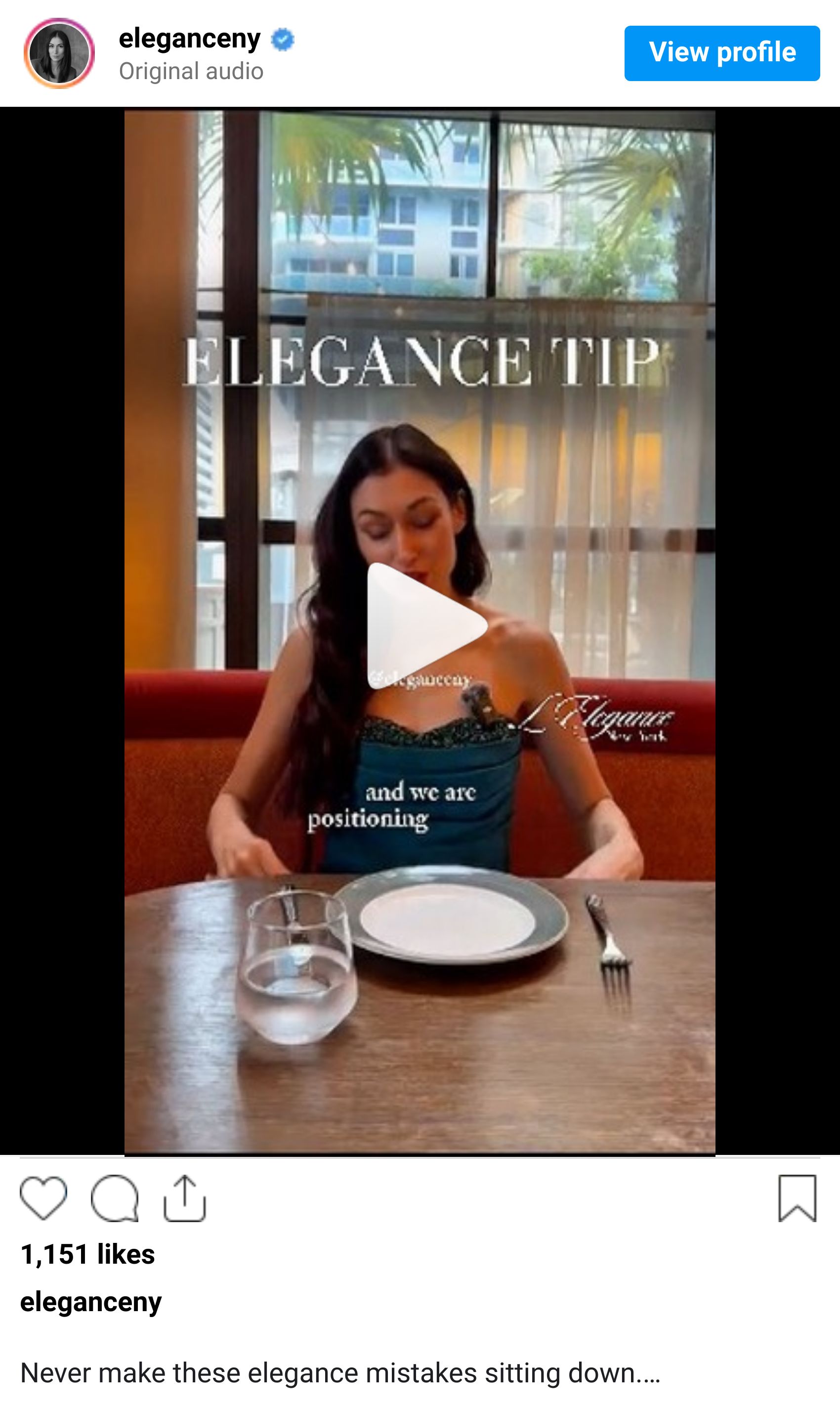
Elegance Tip of the week
Olga’s Recommendations
The Lost Art of Correspondence
I want to address something that separates women who make fleeting impressions from those who create lasting ones: the practice of handwritten correspondence. Yes, sending a quick text or email is efficient, but there are moments – after formal events, following meaningful conversations, or when expressing genuine gratitude – when handwritten notes communicate a level of care and intentionality that digital messages simply cannot match.
The most elegant approach to maintaining relationships and leaving memorable impressions involves keeping a proper letter writing kit at home, ready for those moments when written correspondence matters. I recommend investing in quality stationery from brands like Smythson or Papier – beautiful, heavyweight paper with your name or initials subtly engraved or printed at the top. Choose classic cream or white rather than trendy colors that will date quickly. Pair this with a quality fountain pen that makes the physical act of writing feel substantial rather than rushed, and keep proper stamps on hand so there's no barrier between intention and action.

Credit: Papier
The practice matters more than perfection. After attending dinner parties, write brief notes within 48 hours thanking your hosts with specific mentions of what made the evening special. Following job interviews or important meetings, send handwritten follow-ups that stand out from the dozens of emails your interviewer receives. When someone does you a significant favor, put pen to paper rather than firing off a text. In our increasingly digital world, the woman who maintains this practice doesn't seem old-fashioned – she seems remarkably sophisticated and genuinely thoughtful.
Chelsea Flower Show
The Garden of Social Grace
The RHS Chelsea Flower Show transforms the grounds of the Royal Hospital Chelsea into the world's most prestigious horticultural exhibition, where cutting-edge garden design meets centuries of British gardening tradition. This celebrated event offers more than spectacular floral displays – it demonstrates quintessentially British social etiquette, where understanding when conversation should remain light versus substantive, how to navigate the careful balance between enthusiasm and restraint, and recognizing that queuing properly and respecting personal space are fundamental expressions of respect.

Whether you're planning to attend this iconic event or simply preparing for professional or social engagement in British contexts, remember that true elegance means understanding that what appears informal often operates by quite specific unwritten rules, that understatement carries more weight than obvious displays, and that genuine appreciation expressed with restraint resonates more deeply than effusive declarations.
19 - 23 May 2026
Game
The Elegance Game
In the following week, we will share the answer to this question. Click the answer that you think is right.

When selecting swimwear and beachwear for a luxury resort holiday, what demonstrates the most elegant approach?
- Choose the most revealing, trend-forward pieces to show you're confident and fashion-aware
- Select well-fitted, quality swimwear in classic cuts with thoughtful coverage
- Wear only full-coverage, modest swimwear and always remain fully covered outside the beach to avoid any appearance of impropriety
- Pack exclusively designer pieces with visible logos to signal you belong in luxury settings
